

What Does Naked Eye Mean
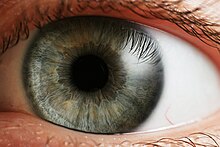
Naked eye, as well called bare centre or unaided eye, is the practice of engaging in visual perception unaided by a magnifying, light-collecting optical instrument, such every bit a telescope or microscope, or eye protection. Vision corrected to normal vigil using cosmetic lenses is still considered "naked".
In astronomy, the naked eye may be used to detect angelic events and objects visible without equipment, such as conjunctions, passing comets, meteor showers, and the brightest asteroids, including iv Vesta. Sky lore and various tests demonstrate an impressive diversity of phenomena visible to the unaided center.
Basic properties [edit]
Some basic properties of the human eye are:
- Quick autofocus from distances of 25 cm (young people) to 50 cm (most people fifty years and older) to infinity.[ citation needed ]
- Angular resolution: about 1 arcminute, approximately 0.017° or 0.0003 radians,[1] which corresponds to 0.three g at a 1 km altitude.
- Field of view (FOV): simultaneous visual perception in an surface area of about 160° × 175°.[2]
- Power to see faint stars up to +8 magnitude under a perfectly dark sky.[three]
- Photometry (brightness) to ±10% or i% of intensity – in a range betwixt night and day of 1:10,000,000,000.[ citation needed ]
- Symmetries of 10–20' (3–6 m per 1 km), run into the measurements of Tycho Brahe.[ commendation needed ]
- Interval estimations (for instance at a plan on paper) to three–5%.[ citation needed ]
- Unconscious recognizing of move (that is "warning organization" and reflexes).[ citation needed ]
Visual perception allows a person to gain much data about their surroundings:
- the distances and 3-dimensional position of things and persons
- the vertical (plumb line) and the gradient of plain objects
- luminosities and colors and their changes by time and direction
In astronomy [edit]

The visibility of astronomical objects is strongly affected past low-cal pollution. Even a few hundred kilometers abroad from a metropolitan area where the sky tin can appear to be very dark, information technology is still the residual light pollution that sets the limit on the visibility of faint objects. For most people, these are probable to be the best observing conditions within their attain. Under such "typical" nighttime sky weather condition, the naked eye can encounter stars with an apparent magnitude up to +6m. Under perfect dark sky conditions where all calorie-free pollution is absent, stars as faint equally +viiithou might be visible.[4]
The angular resolution of the naked heart is about ane′; nevertheless, some people take sharper vision than that. At that place is anecdotal evidence that people had seen the Galilean moons of Jupiter before telescopes were invented.[5] Uranus and Vesta had most probably been seen but could not be recognized every bit planets considering they announced so faint fifty-fifty at maximum brightness; Uranus' magnitude varies from +5.3one thousand to +five.9thousand, and Vesta'southward from +5.2m to +eight.5thou (so that information technology is merely visible near its opposition dates). Uranus, when discovered in 1781, was the outset planet discovered using applied science (a telescope) rather than being spotted by the naked eye.
Theoretically, in a typical dark sky, the night adjusted human center would run across the about 5,600 stars brighter than +6m [six] while in perfect dark heaven conditions about 45,000 stars brighter than +81000 might be visible.[4] In exercise, the atmospheric extinction and grit reduces this number somewhat. In the middle of a city, where the naked-heart limiting magnitude due to extreme amounts of low-cal pollution can exist as depression equally 2thou, every bit few as 50 stars are visible. Colors tin exist seen merely this is limited past the fact that the eye uses rods instead of cones to view fainter stars.
The visibility of diffuse objects such every bit star clusters and galaxies is much more than strongly affected past light pollution than is that of planets and stars. Under typical dark conditions merely a few such objects are visible. These include the Pleiades, h/χ Persei, the Andromeda Galaxy, the Carina Nebula, the Orion Nebula, Omega Centauri, 47 Tucanae, the Ptolemy Cluster Messier 7 well-nigh the tail of Scorpius and the globular cluster M13 in Hercules. The Triangulum Milky way (M33) is a difficult averted vision object and only visible at all if it is higher than 50° in the sky. The globular clusters Thou 3 in Canes Venatici and K 92 in Hercules are besides visible with the naked eye under such conditions. Under really nighttime sky conditions, however, M33 is easy to come across, fifty-fifty in direct vision. Many other Messier objects are also visible under such weather condition.[four] The most afar objects that have been seen by the naked heart are nearby bright galaxies such as Centaurus A,[7] Bode'southward Milky way,[8] [9] [10] Sculptor Milky way,[10] and Messier 83.[eleven]
Five planets can be recognized as planets from Earth with the naked center: Mercury, Venus, Mars, Jupiter, and Saturn. Under typical dark sky conditions Uranus (magnitude +five.viii) can be seen too with averted vision, as can the asteroid Vesta at its brighter oppositions. The Sunday and the Moon—the remaining noticeable naked-eye objects of the solar organization—are sometimes added to make seven "planets." During daylight only the Moon and Sunday are obvious naked eye objects, but in many cases Venus tin can be spotted in daylight and in rarer cases Jupiter. Shut to sunset and sunrise, vivid stars like Sirius or even Canopus can be spotted with the naked eye equally long every bit i knows the exact position in which to await. Historically, the zenith of naked-eye astronomy was the work of Tycho Brahe (1546–1601). He congenital an extensive observatory to brand precise measurements of the heavens without whatever instruments for magnification. In 1610, Galileo Galilei pointed a telescope towards the sky. He immediately discovered the moons of Jupiter and the phases of Venus, amongst other things.
Meteor showers are better observed by naked centre than with binoculars. Such showers include the Perseids (x–12 August) and the December Geminids. Some 100 satellites per night, the International Infinite Station and the Galaxy are other popular objects visible to the naked middle.[12]
xix March 2008 A major gamma-ray burst (GRB) known as GRB 080319B, prepare a new record every bit the uttermost object that can be seen from Earth with the naked heart. Information technology occurred about 7.5 billion years agone, the calorie-free taking that long to reach Earth.
[edit]
Many other things can be estimated without an musical instrument. If an arm is stretched the span of the hand corresponds to an angle of 18 to 20°. The distance of a person, but covered up by the outstretched thumbnail, is nearly 100 meters. The vertical can be estimated to about two° and, in the northern hemisphere, observing the Pole Star and using a protractor can requite the observer's geographic latitude, up to 1 degree of accurateness.
The Babylonians, Mayans, ancient Egyptians, ancient Indians, and Chinese measured all the basics of their respective time and agenda systems past naked eye:
- the length of a year and a month to ±0.one 60 minutes or to better than 1 infinitesimal (0.001%)
- the 24 hours of a twenty-four hours, and the equinoxes
- the periods of the planets were calculated past Mayan astronomers, to within 5 to 10 minutes accuracy in the instance of Venus and Mars.
In a similar manner star occultations by the moon can be observed. Past using a digital clock an accurateness of 0.ii second is possible. This represents only 200 meters at the moon's distance of 385,000 km.
Small objects and maps [edit]
Observing a nearby pocket-size object without a magnifying glass or a microscope, the size of the object depends on the viewing distance. Under normal lighting conditions (light source ~ yard lumens at height 600–700 mm, viewing angle ~ 35 degrees) the angular size recognized by naked middle will be round one arc minute = 1/60 degrees = 0.0003 radians.[1] At a viewing distance of 16" = ~ 400 mm, which is considered a normal reading distance in the United states, the smallest object resolution volition be ~ 0.116 mm. For inspection purposes laboratories apply a viewing distance of 200–250 mm,[ citation needed ] which gives the smallest size of the object recognizable to the naked eye of ~0.058–0.072 mm (58–72 micrometers). The accuracy of a measurement ranges from 0.1 to 0.3 mm and depends on the experience of the observer. The latter figure is the usual positional accuracy of faint details in maps and technical plans.
Environmental pollution [edit]
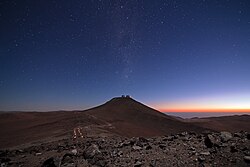
A make clean temper is indicated by the fact that the Milky Way is visible. Comparison the zenith with the horizon shows how the "blue quality" is degraded depending on the corporeality of air pollution and dust. The twinkling of a star is an indication of the turbulence of the air. This is of importance in meteorology and for the "seeing" of astronomy.
Light pollution is a significant problem for amateur astronomers but becomes less late at night when many lights are close off. Air dust can exist seen fifty-fifty far abroad from a city past its "calorie-free dome".
Run across also [edit]
- Satellite flare
- ISS flare
Literature [edit]
- Davidson, North.: Sky Phenomena: A Guide to Naked Eye Observation of the Heavens. FlorisBooks (208p), ISBN 0-86315-168-X, Edinburgh 1993.
- Gerstbach G.: Auge und Sehen – der lange Weg zu digitalem Erkennen. Astro Periodical Sternenbote, 20p., Vol.2000/8, Vienna 2000.
- Kahmen H. (Ed.): Geodesy for Geotechnical and Structural Applied science. Proceedings, Eisenstadt 1999.
References [edit]
- ^ a b Yanoff, Myron; Duker, Jay Due south. (2009). Ophthalmology tertiary Edition. MOSBY Elsevier. p. 54. ISBN978-0444511416.
- ^ Wandell, B. (1995). "Foundations of Vision." Sinauer, Sunderland, MA as cited in Neurobiology of Attending. (2005). Eds. Laurent Itti, Geraint Rees, and John G., Tsotos. Chapter 102, Elder, J.H. et al. Elsevier, Inc.
- ^ "Light Pollution and Astronomy: How Dark Are Your Night Skies?". skyandtelescope.com. 18 July 2006. Archived from the original on 31 March 2014. Retrieved half-dozen August 2013.
- ^ a b c John Eastward. Bortle (February 2001). "The Bortle Night-Sky Scale". Sky & Telescope. Archived from the original on 23 March 2009. Retrieved 18 November 2009.
- ^ Zezong, Xi, "The Discovery of Jupiter's Satellite Fabricated by Gan De 2000 years Earlier Galileo", Chinese Physics 2 (3) (1982): 664–67.
- ^ "Vmag<6". SIMBAD Astronomical Database. Retrieved three December 2009.
- ^ "Aintno Catalog". astronomy-mall.com.
- ^ SEDS, Messier 81
- ^ S. J. O'Meara (1998). The Messier Objects . Cambridge: Cambridge University. ISBN978-0-521-55332-ii.
- ^ a b http://messier.obspm.fr/xtra/supp/m81naked.txt[ bare URL plain text file ]
- ^ Inglis Mike (2007). "Galaxies". Patrick Moore'southward Practical Astronomy Series: 157–189. doi:10.1007/978-i-84628-736-7_4. ISBN978-1-85233-890-9.
- ^ "Night sky and its wonders - Naked eye astronomy | Hurtling Stone". Archived from the original on 21 September 2013. Retrieved 12 September 2013.
- ^ "Mars, 2099?". ESO Motion-picture show of the Calendar week . Retrieved 25 June 2012.
External links [edit]
- Naked Centre Observing in Astronomy
- Naked-Eye Stargazing: Learning the Sky and its constellations
- Naked Eye Navigation, Polynesia Voyages
- Detection of weak optical signals by the human visual organisation: Perspectives in Neuroscience and in Breakthrough Physics [ permanent dead link ]
- The Naked-eye Planets in the Dark Sky (and how to identify them)

What Does Naked Eye Mean,
Source: https://en.wikipedia.org/wiki/Naked_eye
Posted by: bakerhinticitted1990.blogspot.com
0 Response to "What Does Naked Eye Mean"
Post a Comment