

Abbreviation For Millimeters Of Mercury
| millimetre of mercury | |
|---|---|
| Unit of measurement of | Pressure level |
| Symbol | mmHg or mm Hg |
| Conversions | |
| 1 mmHg in ... | ... is equal to ... |
| SI units | 133.3224 Pa |
| English Engineering science units | 0.01933678 lbf/in2 |
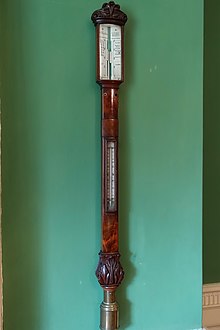
A millimetre of mercury is a manometric unit of pressure, formerly defined every bit the extra pressure generated past a cavalcade of mercury 1 millimetre loftier, and currently divers equally exactly 133.322387 415 pascals.[1] It is denoted mmHg [2] or mm Hg.[3]
Although not an SI unit, the millimetre of mercury is still routinely used in medicine, meteorology, aviation, and many other scientific fields.
Ane millimetre of mercury is approximately 1 Torr, which is 1 / 760 of standard atmospheric pressure ( 101325 / 760 ≈ 133.322368 pascals). Although the two units are not equal, the relative deviation (less than 0.000015% ) is negligible for most practical uses.
History [edit]
For much of human history, the pressure of gases like air was ignored, denied, or taken for granted, but equally early as the 6th century BC, Greek philosopher Anaximenes of Miletus claimed that all things are made of air that is but changed by varying levels of pressure level. He could observe h2o evaporating, changing to a gas, and felt that this applied even to solid thing. More condensed air fabricated colder, heavier objects, and expanded air fabricated lighter, hotter objects. This was alike to how gasses really do become less dense when warmer, more dense when libation.
In the 17th century, Evangelista Torricelli conducted experiments with mercury that allowed him to measure the presence of air. He would dip a glass tube, airtight at one end, into a bowl of mercury and raise the closed finish upwards out of it, keeping the open end submerged. The weight of the mercury would pull information technology downwards, leaving a partial vacuum at the far end. This validated his belief that air/gas has mass, creating pressure level on things around it. Previously, the more popular conclusion, even for Galileo, was that air was weightless and information technology is vacuum that provided force, as in a siphon. The discovery helped bring Torricelli to the conclusion:
We live submerged at the bottom of an ocean of the element air, which by unquestioned experiments is known to have weight.
This test, known equally Torricelli's experiment, was essentially the outset documented pressure approximate.
Blaise Pascal went further, having his brother-in-law try the experiment at different altitudes on a mount, and finding indeed that the farther down in the ocean of atmosphere, the college the pressure.
Mercury manometers were the first accurate pressure gauges. They are less used today due to mercury'south toxicity, the mercury column'south sensitivity to temperature and local gravity, and the greater convenience of other instrumentation. They displayed the pressure difference betwixt two fluids as a vertical deviation between the mercury levels in two connected reservoirs.
An actual mercury column reading may be converted to more fundamental units of pressure by multiplying the departure in elevation between ii mercury levels past the density of mercury and the local gravitational dispatch. Because the specific weight of mercury depends on temperature and surface gravity, both of which vary with local conditions, specific standard values for these two parameters were adopted. This resulted in defining a "millimetre of mercury" equally the pressure level exerted at the base of a column of mercury 1 millimetre high with a precise density of 13595.1 kg/m3 when the dispatch due to gravity is exactly 9.80665 m/sii .[ citation needed ]
The density xiii595.ane kg/m3 chosen for this definition is the judge density of mercury at 0 °C (32 °F), and 9.80665 chiliad/stwo is standard gravity. The use of an actual column of mercury to measure pressure normally requires correction for the density of mercury at the bodily temperature and the sometimes marked variation of gravity with location, and may be further corrected to take account of the density of the measured air, h2o or other fluid.[four]
Each millimetre of mercury tin can be divided into 1000 micrometres of mercury, denoted μmHg or simply microns.[5]
Relation to the torr [edit]
The precision of modern transducers is oft insufficient to show the deviation between the torr and the millimetre of mercury. The divergence between these two units is about ane part in 7 million or 0.000015% .[6] By the aforementioned cistron, a millitorr is slightly less than a micrometre of mercury.
Use in medicine and physiology [edit]
In medicine, pressure is still generally measured in millimetres of mercury. These measurements are in general given relative to the current atmospheric pressure: for example, a blood force per unit area of 120 mmHg, when the current atmospheric pressure is 760 mmHg, ways 880 mmHg relative to perfect vacuum.
Routine pressure level measurements in medicine include:
- Blood pressure level, measured with a sphygmomanometer
- Intraocular pressure, with a tonometer
- Cerebrospinal fluid pressure
- Intracranial pressure level
- Intramuscular pressure (compartment syndrome)
- Cardinal venous pressure
- Pulmonary avenue catheterization
- Mechanical ventilation
In physiology manometric units are used to measure out Starling forces.
| Pascal | Bar | Technical temper | Standard atmosphere | Torr | Pound per foursquare inch | |
|---|---|---|---|---|---|---|
| (Pa) | (bar) | (at) | (atm) | (Torr) | (lbf/inii) | |
| ane Pa | i Pa ≡ 1 Pa | one Pa = ten−5 bar | ane Pa = 1.0197×10⁻⁵ at | 1 Pa = 9.8692×10⁻⁶ atm | 1 Pa = 7.5006×10−three Torr | i Pa = 0.000 145 037 737 730 lbf/in2 |
| one bar | 105 | ≡ 100 kPa ≡ x6 dyn/cm2 | = 1.0197 | = 0.98692 | = 750.06 | = xiv.503 773 773 022 |
| 1 at | 98066.5 | 0.980665 | ≡ ane kgf/cmtwo | 0.967 841 105 354 1 | 735.559 240 i | fourteen.223 343 307 120 3 |
| 1 atm | ≡ 101325 | ≡ i.01325 | one.0332 | 1 | 760 | fourteen.695 948 775 514 2 |
| ane Torr | 133.322 368 421 | 0.001 333 224 | 0.001 359 51 | ane / 760 ≈ 0.001 315 789 | ane Torr ≈ 1 mmHg | 0.019 336 775 |
| 1 lbf/in2 | 6894.757 293 168 | 0.068 947 573 | 0.070 306 958 | 0.068 045 964 | 51.714 932 572 | ≡ 1 lbf/inii |
See too [edit]
- Bar (unit)
- Inch of mercury
- Inch of water
- Pound per square inch
- Torr
References [edit]
- ^ BS 350: Part 1: 1974 – Conversion factors and tables. British Standards Institution. 1974. p. 49.
- ^ International Bureau of Weights and Measures (2006), The International System of Units (SI) (PDF) (8th ed.), p. 127, ISBN92-822-2213-6, archived (PDF) from the original on 2021-06-04, retrieved 2021-12-xvi
- ^ "AMA Manual of Style Online". American Medical Clan. Retrieved 2018-02-24 .
- ^ Kaye, G.W.C.; Laby, T.H. (1986). Tables of Physical and Chemical Constants (15 ed.). Longman. pp. 22–23. ISBN0582463548.
- ^ Hoffman, Dorothy; Singh, Bawa; Thomas, John H. (1998). Handbook of vacuum science and technology (PDF). San Diego, CA: Bookish Press. p. 171. ISBN978-0-12-352065-four. OCLC 162128757.
- ^ "Pressure Units". National Physical Laboratory (NPL). Archived from the original on 28 January 2015. Retrieved 16 September 2020.

Abbreviation For Millimeters Of Mercury,
Source: https://en.wikipedia.org/wiki/Millimetre_of_mercury
Posted by: bakerhinticitted1990.blogspot.com
0 Response to "Abbreviation For Millimeters Of Mercury"
Post a Comment